
For candidates
We place people, not CVs. Apply for a live role, join our talent pool, and use the toolkit below to put your best foot forward.
Two ways to apply
Everything you need to land the role
Real, practical advice from 22 years of placing people. Tap any card to read more.
How to lay out a CV that gets shortlisted, and the mistakes that get one discarded.
Read more →Free interview practice that helps you understand yourself, not rehearse a script, so you walk in ready and win.
Read more →Why they're so tempting, and why the research says they don't work.
Read more →How to resign with integrity and see the move through to the end.
Read more →How to turn an unexpected setback into the next chapter of your career.
Read more →Let's find the right move for you
Apply for a live role, or join our talent pool and we'll match you.
CV formatting tips
When we shortlist, CVs with errors are discarded. A clear, honest, well-ordered CV is your first impression. Make it count.
- Choose a layout and font and keep to it throughout the CV.
- Be honest with your skills and qualifications.
- Ensure there are no spelling or grammatical errors. CVs with errors are discarded when shortlisting.
- Keep it neat, orderly and easy to read: less than 5 pages.
- If you include a photo, use a small, professional one on the front page only.
- Put your personal contact details on the front page.
- List work history in reverse chronological order: most recent first, working back.
- Ensure dates are correct for each role, with no unexplained gaps.
- List your most relevant responsibilities under each role. Avoid lengthy story-format paragraphs.
- Highlight major achievements specific to each role you've performed.
- Include education from high school to tertiary qualifications and certificates, and note whether each is completed or in progress.
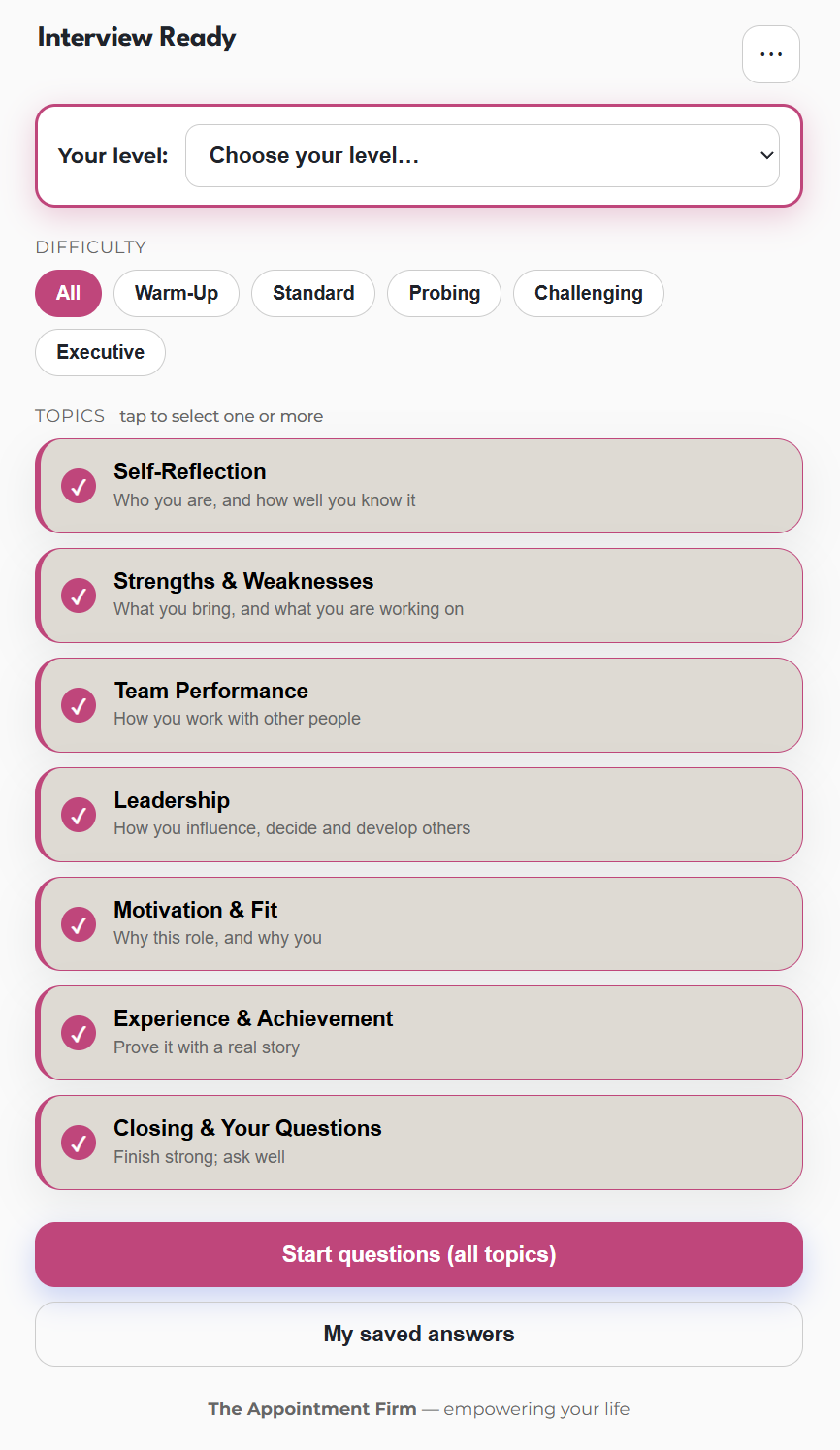
Interview Ready
Free interview practice from The Appointment Firm
Interviews aren't won by memorising clever lines or dressing up a CV. They're won by knowing yourself well enough to answer honestly and with confidence.
Interview Ready is our free tool to help you do exactly that. Work through the real questions interviewers actually ask, one at a time, with guidance on what each one is really testing and how to shape a strong answer. Then write your own answer, save it, and come back to it.
This isn't about rehearsing a script. It's about slowing down, digging in, and genuinely understanding who you are and what you bring, so the person in the room is the real you, at your best.
Free, because people matter to us. Because we'd rather help you win.
The Appointment Firm
Counter offers
Why do so many people accept counter offers, when in our experience they so rarely work out?
- Comfort zone. We gravitate to the familiar over the uncertain. More comfortable doesn't mean it's the right move.
- Growth = pain. You resigned because you'd plateaued. Growth brings more responsibility and, at first, feeling out of your depth. That's normal. Embrace it rather than getting stuck in a rut.
- Emotional ties. People work for people. Loyalty to a manager or team makes leaving harder.
- Even more money. Some employers don't just match: they beat the offer. Money is short-lived and can price you out of the market later.
- Many promises. New roles, development plans and opportunities appear after you resign. Ask yourself why they only arrive once you've handed in your notice.
Why counter offers don't work
- A counter offer does not address the real reasons you looked elsewhere. Those reasons resurface within months.
- In our experience it is mostly about the company, not you: a reaction to buy time and put a succession plan in place.
- Your loyalty is now questioned. The relationship dynamic changes and can turn to resentment.
- Your future prospects are affected: the company whose offer you turned down (and the recruiter who acted for you) are left disgruntled.
Resigning from a company
Understand why you're moving, then see the process through with integrity and professionalism.
- Keep it short and simple. Avoid prolonged discussions about why you're leaving.
- Be formal and polite. This letter stays on your record for years; never write it emotionally.
- Schedule an appointment with your manager to inform them of your resignation.
- Avoid over-sharing. You don't have to say where you're going; keep it confidential for now and offer to stay in touch.
- Make it clear the decision was not taken lightly and that your mind is made up.
- When they try to entice you to stay, don't give false hope. A final decision allows a smoother transition.
- Don't tell co-workers anything you wouldn't want your manager to hear. It will get back.
- Be professional to the end and leave with your integrity intact.
- Expect the counter offer. In the placements we have handled over the years, accepting one is usually a decision people come to regret.
- Stay strong and focused through your notice period. The opportunity you worked for is on the other side.
Handling retrenchment
Retrenchment is often unexpected and stressful, but it can be a beginning, not an end.
- Life could be better after retrenchment. Many land better jobs and are happier for the change they wouldn't have made themselves.
- Keep your costs contained and debt-free. Save while employed. Overcommitment turns a setback into desperation.
- Rebrand yourself. Take stock, update your CV, refresh LinkedIn and reconnect with people.
- Embrace change. Be open to new ideas and see uncertainty as a learning opportunity.
- Consider starting your own business. If you've always wanted to, now could be the time.
- Mourn the loss quickly and move on. Dwelling feeds a negative mindset.
- Develop a positive mindset. Confidence shows in interviews. Practise being positive even when it's hard.
- Make daily activity your job. Get up early, work on your CV, make calls, apply. Consistent activity produces results.
- Sell yourself. Everyone sells: your attitude, ideas, skills and smile. What are you selling, and are people buying?
- See it as the beginning. Speak to a coach or recruiter and embrace the next chapter.